



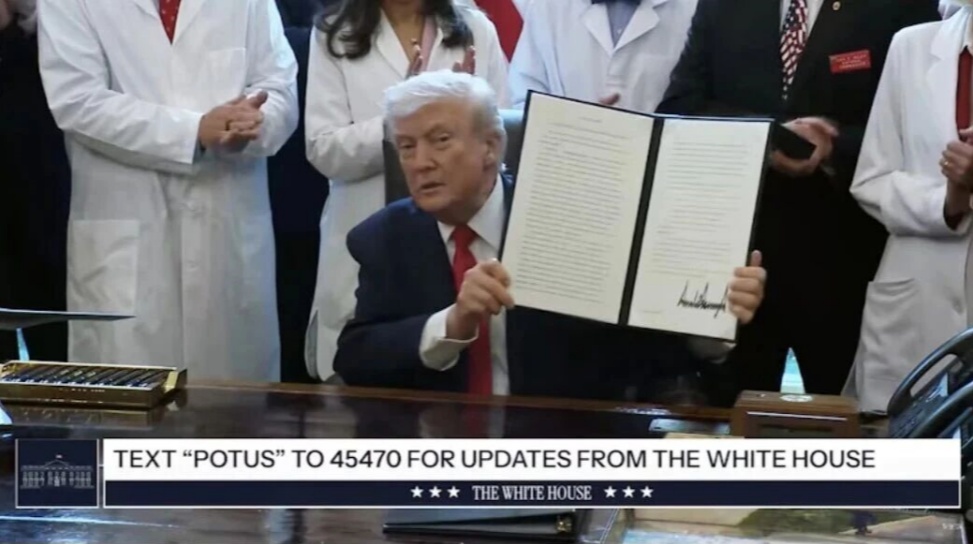
The global cannabis industry will forever remember this day! On December 18, President Trump issued an executive order urging the Attorney General to reschedule cannabis to a lower classification while also including CBD under federal healthcare coverage. President Donald Trump signed an executive order on December 18, instructing his administration to ease restrictions on cannabis by rescheduling it to Schedule III under the Controlled Substances Act (CSA).
Farewell, burdensome taxes under federal Internal Revenue Code Section 280E. Welcome, accepted medical uses of cannabis.
“This is an important day for many reasons. Today, I am proud to announce that I will sign an executive order to reschedule cannabis from a Schedule I controlled substance to a Schedule III controlled drug for legitimate medical purposes,” Trump said at Thursday’s signing ceremony. “For decades, this action has been demanded by American patients suffering from severe pain, incurable diseases, aggressive cancers, seizure disorders, neurological issues, and more.”
The order directs the Department of Justice (DOJ), through Attorney General Pamela Bondi, to “expedite the completion” of the rulemaking process for removing cannabis from Schedule I, where it has been listed alongside heroin, LSD, and ecstasy as drugs with the highest potential for abuse ever since President Richard Nixon signed the Comprehensive Drug Abuse Prevention and Control Act into law over 50 years ago.
While this major decision from the White House does not decriminalize cannabis, the reform from Schedule I to Schedule III goes a long way toward further normalizing cannabis, particularly by having the federal government acknowledge its medical value by removing it from Schedule I.
“Today’s historic announcement to reschedule cannabis to Schedule III marks a pivotal moment in recognizing that cannabis has an accepted medical use, finally enabling America’s next great homegrown industry to realize its full potential by serving patients, creating jobs, unlocking economic growth, and reversing decades of harmful prohibition policies,” said George Archos, founder and CEO of Verano, one of the largest multi-state operators in the U.S., in a statement.
While placing cannabis on Schedule III does not in itself legalize medical cannabis, Trump’s order stipulates that rescheduling will allow research to “incorporate real-world evidence and models to evaluate the health outcomes of medical cannabis and legal CBD products, while focusing on long-term health effects for vulnerable populations such as adolescents and young adults.”
Cannabis industry stakeholders have long debated whether Schedule III classification would streamline approval processes for scientists and researchers hoping to conduct clinical trials, and whether it would incentivize the U.S. Food and Drug Administration to approve more cannabinoid-based drugs.
But Trump made his intentions clear: remove barriers to medical cannabis research.
“This rescheduling order will make it much easier to conduct medical research related to cannabis, allowing us to study its benefits, potential risks, and future treatments,” he said. “I believe this will have a very positive impact.”
One of the most impactful effects of reclassifying the plant to Schedule III is that it would allow state-approved cannabis businesses to begin deducting ordinary business expenses—such as payroll, rent, and utilities—from their federal taxes. While most U.S. companies only pay taxes on their profits, businesses operating under Schedule I or II substances face tax deduction obstacles on their operating expenses under Section 280E of the U.S. Internal Revenue Code.
This burdensome tax rule has severely hindered the growth of cannabis businesses.
According to industry data and analytics providers, for the average U.S. cannabis dispensary, placement on Schedule III could mean annual tax savings of $268,000, with stores in higher-revenue states saving as much as $805,000 per year. The agency modeled estimates for a median store across 24 state markets (2,176 stores), with the benchmark assuming typical retail operational expenses of 35% of sales, taxed at a 21% federal rate.
On the consumer side, Trump’s order also directs the White House Deputy Chief of Staff for Legislative, Political, and Public Affairs to work with Congress to find a regulatory pathway to ensure Americans have safe access to non-intoxicating, full-spectrum hemp-derived CBD products.
More specifically, the order directs the U.S. Department of Health and Human Services (HHS) to help improve safe access to hemp-derived cannabinoid products by developing research, utilizing real-world evidence, and informing “standards of care.”
Under HHS, the Centers for Medicare & Medicaid Services (CMS), under Director Mehmet Oz, will adopt a new policy allowing doctors to recommend CBD products as alternative treatments to senior Americans and permitting their Medicare coverage to pay for them. This aligns with a video Trump shared in September advocating for CBD to be included in the healthcare system for Americans aged 65 and older.
Oz said at the signing ceremony that federal Medicare coverage for CBD products could begin as early as April. Medicare covers over 68 million Americans.
“Today, we are announcing a new model and additional actions at CMS’s Innovation Center to give seniors access to cannabinoids,” Oz said. “CBD is not addictive, and many people are already using it to manage pain. Some clinical evidence shows CBD can alleviate common conditions affecting Americans, including cancer symptoms and chronic pain, as well as many other issues that disproportionately affect seniors and veterans. Six out of ten people who use CBD report that it improves their pain.”
While some news reports speculated that the executive order would urge Congress to pass banking legislation for the cannabis industry and/or grant clemency to certain individuals convicted of minor, non-violent cannabis offenses, these items were not included.
However, the order fulfills a campaign promise Trump made in late 2024, when he said he would “focus on research to unlock the medical uses of cannabis, making it a Schedule III drug.”
Trump also said in 2024 that he would work with Congress to pass a safe banking act and support criminal justice reform: “I believe it is time to end unnecessary arrests and incarcerations of adults for possessing small amounts of cannabis for personal use.”
Health Secretary Robert F. Kennedy Jr., who has publicly supported cannabis reform, praised Trump for keeping his campaign promise to support rescheduling cannabis.
“Five administrations have promised to take action on this issue,” Kennedy said. “The Biden administration also promised to do it, and the proposal began under the Biden administration. But it got bogged down in chaos, inertia, and confusion.”
Trump’s decision to reschedule cannabis represents more than just a policy shift—this major change is supported by a majority of Americans (Trump cited 82%); it illustrates how existing policies have deviated from the current direction of cannabis reform, largely driven by Democrats. For example, all 11 states that have legalized adult-use cannabis through legislation did so with Democratic majorities in their state legislatures.
When Joe Biden initiated the current federal cannabis rescheduling process by directing his administration in October 2022 to “review” cannabis, the former president didn’t even order his executive agencies to actually implement the HHS recommendation to reschedule cannabis to Schedule III, despite it being backed by 252 pages of scientific and medical evidence.
Instead, the Biden administration’s former DEA Administrator Anne Milgram stood idly by, opposed the recommendation, and delayed and obstructed the rescheduling process by authorizing an administrative law judge to debate the merits of the Biden Justice Department’s case at a hearing, pitting parties opposed to rescheduling against pro-cannabis parties.
Clearly, the Trump administration learned from that debacle and “expedited” the process, signaling his support for moving directly to a final rule.
While the president cannot unilaterally reschedule cannabis, Trump has made the final call, directing Bondi to do so—something he has been publicly considering since August.
The president said Thursday, “I have never been inundated by so many people over this rescheduling.”
Post time: Dec-23-2025